
Share this post:
Quick summary: Building Regulations Part F
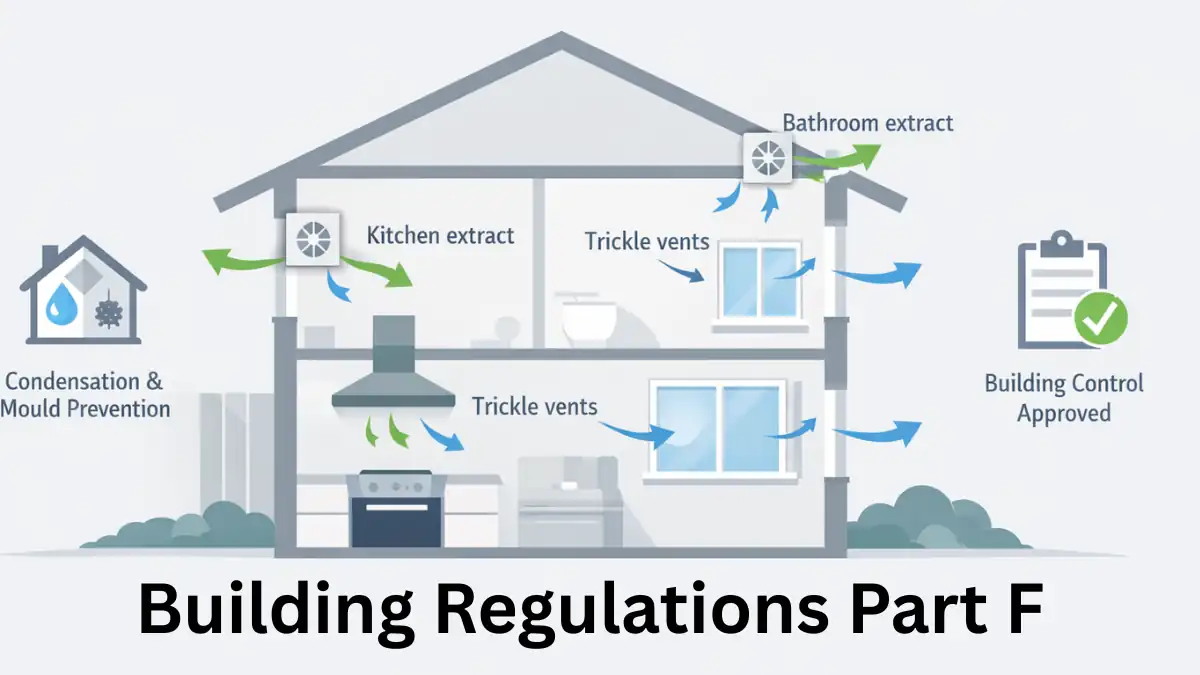
Building Regulations Part F is the UK ventilation standard that helps prevent condensation, mould, and poor indoor air quality by setting minimum requirements for extract ventilation (kitchens/bathrooms), background ventilation (e.g. trickle vents), and whole-dwelling airflow.
- It applies to new builds and to lots of “normal” home projects — including extensions, loft conversions, adding bathrooms/utility rooms, and replacing windows (where ventilation must not be made worse).
- Key numbers homeowners often bump into: kitchen extract is typically 30 l/s (to outside) or 60 l/s (no outside extract); bathrooms are 15 l/s; and “whole house” ventilation depends on floor area and bedroom count.
- Trickle vents are measured by “equivalent area” (mm²) — not just “does the window have a vent?”. Building Control may ask how you’ve met those minimum sizes.
- Commissioning and handover matter: for many systems, evidence and user information are part of compliance, not an optional extra.
If you’re altering your home, we always recommend planning ventilation early — it’s far easier (and cheaper) than being asked to retrofit fans, trickle vents, or ductwork at the final inspection.
Not sure what ventilation you’ll need to pass Building Control?
Tell us what you’re building (extension, loft, new bathroom, window replacement) and we’ll sense-check the likely ventilation approach before you commit to layouts or quotes.
What Building Regulations Part F actually covers (in plain English)
Building Regulations Part F is all about making sure there is adequate ventilation in a home. In practice, that means:
- Getting moist, stale air out (especially from kitchens, bathrooms, utility rooms and WCs).
- Bringing fresh air in (often via background ventilators such as trickle vents, or a mechanical supply system).
- Allowing air to move through the home (transfer paths like door undercuts matter more than people realise).
- Being able to “purge” air quickly (usually openable windows/doors of sufficient size).
When Building Regulations Part F applies to home projects
Homeowners often assume Part F is only for new builds. In reality, it comes up all the time on typical projects, including:
- Extensions (especially open-plan kitchen/dining spaces and utility rooms).
- Loft conversions (new bathrooms/ensuites and new bedrooms need ventilation considered).
- Garage conversions (you’re changing a “cold” space into a habitable room).
- Replacing windows (you must not make ventilation worse, and background ventilators may be required).
- Adding or refurbishing wet rooms (bathrooms, shower rooms, utility rooms, WCs).
It also interacts with other Building Regulations Parts. For example, improving insulation and airtightness (often driven by energy standards) can mean you need a clearer ventilation plan to keep moisture under control.
Building Regulations Part F ventilation systems (the 4 main “routes”)
Approved guidance groups typical dwelling ventilation into four common “systems”. You don’t need to memorise them, but it helps to recognise what your builder is proposing:
- System 1: background ventilators (e.g. trickle vents) + intermittent extract fans.
- System 2: passive stack ventilation (less common in many modern domestic projects).
- System 3: continuous mechanical extract ventilation (MEV) — a central fan extracting from wet rooms.
- System 4: mechanical ventilation with heat recovery (MVHR) — supply + extract with heat recovery.
Quick costs snapshot: what homeowners typically pay for ventilation upgrades
Costs vary by layout, duct routes, electrical work and finish. The point of this snapshot is to help you budget early, not to replace a proper quote.
- Upgrade a bathroom fan: often the cost of a better fan + electrical works (and sometimes making good).
- Kitchen extract to outside: can be straightforward if there’s a short duct route, but costs rise if you need long ducting or awkward routing.
- Whole-house systems (MEV/MVHR): higher upfront cost, but can be the cleanest way to meet airflow targets in airtight homes.
Key Building Regulations Part F numbers homeowners should know
You don’t need to design ventilation yourself — but knowing the headline figures helps you spot problems early (for example, a recirculating cooker hood being treated as “ventilation”).
1) Extract fan rates (intermittent fans)
Minimum intermittent extract rates are typically:
- Kitchen: 30 l/s (if a cooker hood extracts to the outside) or 60 l/s (if there is no outside extract).
- Utility room: 30 l/s.
- Bathroom: 15 l/s.
- WC (sanitary accommodation): 6 l/s.
2) Whole-dwelling ventilation (fresh air supply)
Guidance sets minimum whole-dwelling ventilation rates based on internal floor area and the number of bedrooms (for example, a 3-bedroom home has a minimum rate shown in the approved table).
3) Background ventilation and trickle vents (“equivalent area”)
Background ventilators are sized using equivalent area (mm²) — and the guidance gives minimum values for different rooms and dwelling types. For example, for natural ventilation, habitable rooms and kitchens can require 8,000–10,000mm² depending on the dwelling type, and bathrooms typically 4,000mm².
Building Regulations Part F for existing homes: windows, extensions and “don’t make it worse”
A big Part F theme for homeowners is: don’t reduce ventilation when you improve the building fabric. This often comes up when you replace windows or make a home more airtight.
Replacing windows: do you need trickle vents?
If your replacement windows remove existing vents — or if the home relied on leaky frames for airflow — Building Control may expect background ventilation to be maintained or improved. The guidance gives specific minimum equivalent areas for background ventilators when windows are replaced.
Extensions and loft conversions: new rooms mean new ventilation thinking
Adding habitable rooms and new wet rooms changes the ventilation balance. Even if the existing house “seems fine”, the new layout (open-plan spaces, longer internal air paths, bigger kitchens) can mean you need better extract and a clearer supply route.
If your project is in a listed building or conservation area, ventilation measures may need a more sensitive approach — and it’s worth discussing practical options early so you don’t end up with last-minute compromises.
Worried Building Control will flag ventilation at inspection?
We can review your plans and highlight the common ventilation issues before you build — so you avoid rework, delays, and awkward retrofits.
Step-by-step: how to plan ventilation that passes inspection
If you want a simple way to stay on track with Building Regulations Part F, this process keeps things practical:
Checklist: Part F ventilation plan for a typical home project
- List what’s changing. New kitchen? New bathroom? More bedrooms? Replacement windows? Airtightness upgrades?
- Decide your ventilation “route”. Is it a simple extract + background ventilator approach, or a whole-house system (MEV/MVHR)?
- Plan extract locations and duct routes early. Fans work best with short, sensible ducting and a clear external termination.
- Confirm minimum extract performance. Especially for kitchens and bathrooms — and be careful with recirculating-only cooker hoods.
- Confirm background ventilation provision. Check “equivalent area” requirements and avoid relying on window gaps or night latches.
- Don’t forget airflow through the home. Door undercuts and transfer paths can be part of the inspection conversation.
- Plan for commissioning and handover. Make sure the installer can provide evidence/records where required.
Common Part F pitfalls (and how to avoid a last-minute fail)
1) Treating “a fan exists” as the same thing as “a fan complies”
Many fans are installed without checking performance, duct length impact, or correct positioning. Guidance also sets expectations on where fans should be placed (for example, high in the room).
2) Forgetting that replacement windows can trigger ventilation upgrades
If you remove old vents (or reduce air leakage significantly), Building Control may expect you to provide background ventilation to keep overall provision from getting worse.
3) Blocking vents because they feel “draughty”
It’s very common for homeowners to close trickle vents permanently — and then wonder why condensation starts. If your home feels draughty, the answer is usually better control and balancing, not removing ventilation altogether.
4) Leaving ventilation decisions until after first fix
Ventilation is easiest when it’s planned alongside layouts and structural decisions. Retrofitting ducts through steels, joists, or finished ceilings is where costs and stress climb.
Related comparisons homeowners often search for
- Building Regulations Part F vs Part L: energy upgrades and airtightness can increase the need for a proper ventilation strategy.
- Building Regulations Part F vs Part B: if you’re changing layouts, fire safety and escape can run alongside ventilation decisions.
- Part F Volume 1 vs Volume 2: Volume 1 covers dwellings; Volume 2 is for buildings other than dwellings.
FAQs: Building Regulations Part F
What is Building Regulations Part F?
Building Regulations Part F is the ventilation requirement in the Building Regulations. The approved guidance explains how to provide adequate ventilation for people in the building, including extract ventilation, background ventilation and whole-dwelling airflow.
What are the minimum extract fan rates for kitchens and bathrooms?
For intermittent extract systems, kitchens are typically 30 l/s where a cooker hood extracts to the outside, or 60 l/s where there’s no outside extract. Bathrooms are typically 15 l/s, utility rooms 30 l/s, and WCs 6 l/s.
Does a recirculating cooker hood meet Building Regulations Part F?
On its own, a recirculating cooker hood is not treated as providing compliant “extract to outside” ventilation. If your kitchen ventilation relies on a hood, you may need an outside-extract route or an alternative extract strategy.
Do replacement windows need trickle vents under Part F?
Often, yes — especially if replacing windows removes existing ventilators or reduces background airflow. The guidance sets minimum background ventilator “equivalent area” figures for rooms, and it also discusses how to ensure ventilation is no worse after window replacement.
What does “equivalent area” mean for trickle vents?
“Equivalent area” is the measure used in the guidance to size background ventilators (including trickle vents). It’s expressed in mm² and should be marked on the ventilator so compliance can be checked.
Is Building Regulations Part F the same across England, Wales, Scotland and Northern Ireland?
No. England uses Approved Documents for Building Regulations guidance; Wales has its own Approved Document editions; Scotland uses Technical Handbooks; and Northern Ireland uses Technical Booklets for ventilation requirements and guidance.
How often are Building Regulations updated?
There isn’t a fixed schedule — updates happen when government changes regulations and publishes updated approved guidance. If you’re planning work, it’s wise to check you’re using the current official guidance (and to note any transitional arrangements for applications already submitted).
Want a quick sanity check before you build?
We can highlight the usual Part F ventilation “pain points” on drawings and help you avoid expensive changes at final inspection.
Next steps & useful guides
Ventilation is only one part of passing compliance smoothly. These guides are useful next reads:
- Our complete homeowner guide to the rules you’ll be checked against
- How the inspection process works (and what inspectors look for)
- What drawings you usually need for Building Control sign-off
- Understanding approval routes and what “compliant” actually means
- Why the completion certificate matters (especially when you sell)
- How energy upgrades can affect airtightness and ventilation decisions
- If you’re changing layouts, don’t forget fire safety requirements
- What Part F coversAdequate ventilation for people in buildings, including extract, background and whole-dwelling ventilation guidance.
- Typical extract ratesKitchen 30 l/s (outside extract) or 60 l/s (no outside extract); bathroom 15 l/s; utility 30 l/s; WC 6 l/s (intermittent extract systems).
- Trickle vents measurementBackground ventilators are sized using equivalent area (mm²) and should be marked for verification.
- Common “hidden” issueWindow replacement and airtightness upgrades can require ventilation improvements so provision is not made worse.
- England vs the rest of the UKEngland uses Approved Document F; Wales, Scotland and Northern Ireland use their own guidance and standards for ventilation.
Not sure what applies to your project? Ask Plans Made Easy to sense-check your drawings before you build.
Official guidance
For the current official documents and transitional arrangements, it’s always worth checking:
- GOV.UK – Ventilation: Approved Document F (official landing page)
- Approved Document F (Volume 1: Dwellings) PDF
- Planning Portal – national guidance (useful if your project also needs planning approval)
- GOV.UK – planning permission in England and Wales
How Plans Made Easy can help
Building Regulations Part F is one of those areas that looks simple — until you’re mid-build and someone asks, “Where’s the fresh air coming from, and how is moisture being extracted?”.Getting ventilation right early helps you avoid condensation problems, awkward duct routes, and delays to sign-off.
Our team can help you produce clear, compliant drawings for Building Control, coordinate the details that often get missed, and guide you through the inspection process so your project finishes cleanly.
Ready to move your project forward?
Plans Made Easy can prepare compliant plans, manage submissions, and guide you from idea to approval.

Performance Verified ✅
This page meets PME Optimisation Standards — achieving 95+ Desktop and 85+ Mobile PageSpeed benchmarks. Verified on

