
Share this post:
Quick summary: Building Regulations Part B
If you’re extending your home, Building Regulations Part B is the section that deals with fire safety — things like escape routes, fire doors, smoke alarms, and how fire could spread within (and between) buildings.
- Most home extensions and loft conversions are affected — even if you don’t need planning permission.
- Open-plan layouts are a common “gotcha” because they can remove the protected escape route to your front door.
- External wall changes near boundaries matter (windows, cladding systems, and cavity barriers can trigger extra requirements).
- Building Control is the decision-maker — your inspector will check the approach via Full Plans or a Building Notice.
- Rules can change over time, so it’s smart to confirm you’re working to the latest guidance before you finalise drawings.
In the guide below, we explain what Part B typically means for house extensions in plain English, what Building Control tends to look for, and how to avoid the delays that happen when fire safety is left until late in the project.
Worried your extension design might fail fire safety checks?
Share your plans with our team and we’ll highlight the common Part B “trip points” before Building Control does.
What Building Regulations Part B is (in plain English)
Building Regulations Part B is the fire safety part of the Building Regulations. In homeowner terms, it’s about making sure people can get out safely if there’s a fire, and reducing how quickly fire and smoke could spread.
For most typical house extensions, the checks are practical and familiar — things like smoke alarms in the right places, sensible escape routes, and (sometimes) upgrading doors or plasterboard to slow fire spread.
Approved Document B: the guidance behind Part B
You’ll often hear designers and inspectors mention “Approved Document B”. That’s the main guidance document used to show how a project can meet Part B fire safety requirements.
For homeowners, the key point is simple: your drawings and build details need to match what Building Control expects for your type of project — and that expectation can differ depending on whether you’re extending a house, converting a loft, or creating a new flat.
How Part B typically affects home extensions
Fire safety can sound intimidating, but most extension projects revolve around a few recurring themes. If you understand these early, you avoid the painful “redesign” moment after your builder has already priced the job.
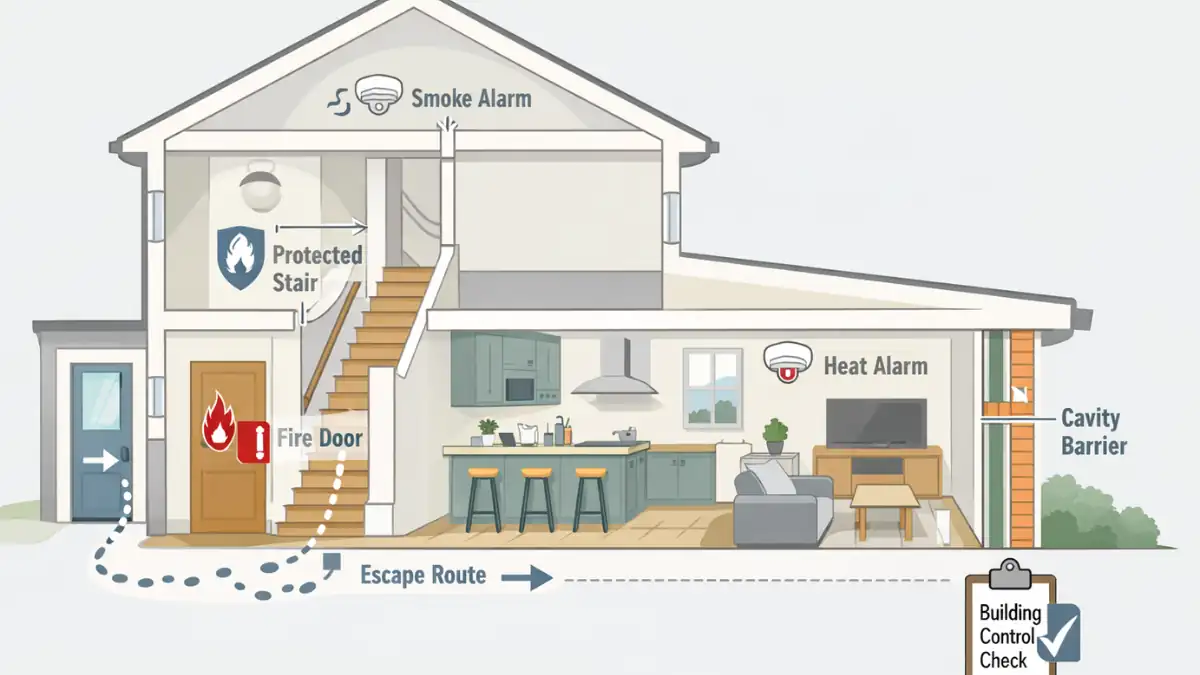
1) Escape route: can you still get out safely?
Building Control will look at how you escape from bedrooms (especially first floor and loft rooms) and whether you still have a reasonable route to a final exit (normally your front door).
- Loft conversions commonly trigger a stronger focus on a protected stair route and fire doors.
- Rear extensions can affect escape if you remove internal walls and create a big open-plan ground floor.
- New internal layouts can matter as much as the extension size, because smoke spread is often the real risk.
2) Fire doors and separation: slowing down smoke and fire
In many homes, Part B upgrades show up as fire-resisting doors (often to rooms opening onto the stairs) and improved separation between spaces. This is particularly common when a loft conversion is involved, or when the stair becomes the main escape route for an extra floor.
Your inspector may also care about separation between:
- Integral garages and the house,
- New rooms and the protected stair route,
- Higher-risk areas (kitchens, utility rooms) and escape routes.
3) Smoke and heat alarms: often simple, but must be right
Most extension projects need a sensible, interconnected alarm approach — usually smoke alarms in circulation spaces (hallways/landings) and a heat alarm in the kitchen area.
4) External walls near boundaries: cladding and cavity barriers
Extensions can bring new external walls closer to boundaries, add different cladding finishes, or change window positions. Where a wall is close to a boundary, Building Control may focus more on limiting external fire spread.
If your project includes cladding, warm roof build-ups, or insulated cavities, it’s also normal for inspectors to ask about cavity barriers and how fire spread is being controlled within the wall build-up.
5) Access for the fire service (where relevant)
Most standard householder extensions don’t involve “fire engine access design” in the way large developments do. However, inspectors still consider whether the layout creates obvious problems for access or escape — particularly for more complex schemes or conversions.
Common fire safety checks for extensions (simple checklist)
Every home is different, but if you’re planning an extension, these are the fire safety items we see Building Control come back to most often:
- Escape route: clear route to a final exit, especially from first floor and loft rooms.
- Protected stair: whether the stairs need additional protection when adding habitable rooms above.
- Door upgrades: whether doors opening onto the stair route need improved fire resistance.
- Detection: appropriate smoke/heat alarms, correctly positioned and (where required) interconnected.
- Separation: between garage/house, and between higher-risk rooms and escape routes.
- External fire spread: boundary distances, new openings, and suitable wall build-ups.
- Hidden voids: cavity barriers and fire stopping, particularly around new steelwork and services.
Quick “early check” you can do before drawings are final
- Mark your escape route from each bedroom to the final exit.
- Circle the highest-risk room (often the kitchen) and see if the escape route passes through it.
- Check your stair: is it the only escape route for an added storey (loft conversion)?
- Note any new external wall close to a boundary and flag it to your designer.
- Ask Building Control early if the scheme is non-standard (large open plan, unusual cladding, complex layout).
Changes to Part B: why “latest guidance” matters
Homeowners often ask whether the rules have changed — and the honest answer is: the guidance does get updated. Approved Document B has been amended over time, and there are also transitional arrangements that can affect which version applies to your project depending on timing and the type of Building Control submission.
If you want to check the official documents yourself, use the GOV.UK Approved Document pages and the Planning Portal’s Building Regulations guidance. (We’ve linked these near the end of this guide.)
Not sure what Part B will mean for your layout?
Send us your rough plans or sketch and we’ll explain the likely fire safety requirements before you waste money on redesigns.
Step-by-step: how to stay compliant and avoid delays
The easiest way to reduce stress is to treat fire safety as a design input, not an afterthought. Here’s the process we recommend for homeowners.
Step-by-step: getting Part B right on an extension
- Start with your layout goals (open plan, extra bedroom, larger kitchen) and identify the likely “risk areas” early.
- Choose your Building Control route (Full Plans vs Building Notice) based on complexity and how much certainty you want upfront.
- Get drawings that show what matters — including doors, stairs, room uses, and any relevant wall build-ups near boundaries.
- Agree the approach with Building Control early, especially if the design is non-standard (big open plan, unusual glazing, specialist cladding).
- Plan the inspection points so fire stopping, cavity barriers, and hidden details are checked before they’re covered up.
- Keep compliance evidence (product specs, installation info, certificates) so completion runs smoothly — and you have paperwork for future buyers.
If you want a clearer sense of what inspectors look for in real life, our guides onhow Building Control checks workandwhat happens during inspectionsare a good next read.
FAQs: Building Regulations Part B
Do I need to follow fire safety rules if my extension doesn’t need planning permission?
Yes — planning permission and Building Regulations are separate systems. Even if your work is permitted development, Building Control can still require fire safety measures as part of compliance.
Which document do Building Control officers use for Part B fire safety?
Most inspectors refer to Approved Document B (Fire Safety) as the main guidance. What applies can depend on whether you’re working on a house, a flat, or a non-domestic building — so it’s worth confirming early for your specific project type.
What’s the difference between Approved Document B Volume 1 and Volume 2?
Volume 1 is primarily aimed at dwellings (homes), while Volume 2 covers buildings other than dwellings. For most standard house extensions, you’ll generally be in “dwelling” territory, but mixed-use or unusual projects can be different — Building Control will confirm what they expect.
Will I need fire doors in a typical home extension?
Sometimes. Fire doors tend to come up more often when a project affects the main escape route — for example, if you’re adding habitable rooms in a loft conversion or altering the stair route. Your inspector will look at the overall escape strategy rather than applying a “one size fits all” answer.
Does an open-plan kitchen extension cause Building Control problems?
It can do. Open plan isn’t “banned”, but it can remove the separation that protects the escape route. The fix might be layout adjustments, enhanced detection, or other measures agreed with Building Control — which is why it’s best discussed before drawings are final.
How often do Building Regulations change?
Guidance and requirements can be amended over time, and there can be transitional arrangements that decide which version applies to a particular project. In practice, your designer and Building Control should confirm the relevant edition before you proceed.
What is Regulation 38 and does it affect homeowners?
Regulation 38 relates to handing over relevant fire safety information on completion (so the building can be operated and maintained safely). It’s more commonly discussed on larger or more complex projects, but it’s still a useful reminder to keep product details, certificates, and “as built” information where applicable.
Next steps & useful guides
If you’re planning an extension and want to understand the wider compliance picture (not just fire safety), these guides will help:
- A simple extension rules checklist (planning + Building Control)
- Understanding the two main Building Control routes
- What drawings Building Control usually wants (and when)
- How the approval process works from start to finish
- Why completion paperwork matters for future buyers
- What compliance documents you should keep
- What it coversFire safety: escape routes, smoke/heat detection, fire spread within the home, and external fire spread risks.
- Who enforces itBuilding Control (local authority or an approved inspector), not the planning department.
- Common extension triggersOpen-plan layouts, loft conversions, altered stairs, garage-to-house separation, and new external walls close to boundaries.
- Best way to avoid delaysDiscuss the escape route and detection strategy early, and make sure your drawings show the key details Building Control needs.
- Why “latest guidance” mattersApproved guidance is updated over time; confirm the applicable edition and transitional arrangements before you finalise designs.
Want us to review your layout for likely compliance issues? Message Plans Made Easy and we’ll talk you through the risks and options.
Official guidance
For the latest official guidance, it’s worth checking:
- Planning Portal – guidance on permissions and Building Regulations
- GOV.UK – planning permission in England and Wales
- GOV.UK – Approved Document B (Fire Safety) downloads and updates
How Plans Made Easy can help
Most fire safety issues on extensions aren’t “mystery rules” — they’re predictable design pinch points that are much easier to solve on paper than on site.If you’d like a calm, practical steer before you commit, we can review your proposed layout, explain what Building Control is likely to focus on, and help you prepare drawings that reduce back-and-forth.
Ready to move your extension forward?
Plans Made Easy can prepare compliant drawings, support Building Control submissions, and help you avoid the common fire safety delays.
Performance Verified ✅
This page meets PME Optimisation Standards — achieving 95+ Desktop and 85+ Mobile PageSpeed benchmarks. Verified on

