
Share this post:
Quick summary: Building Regulations Application
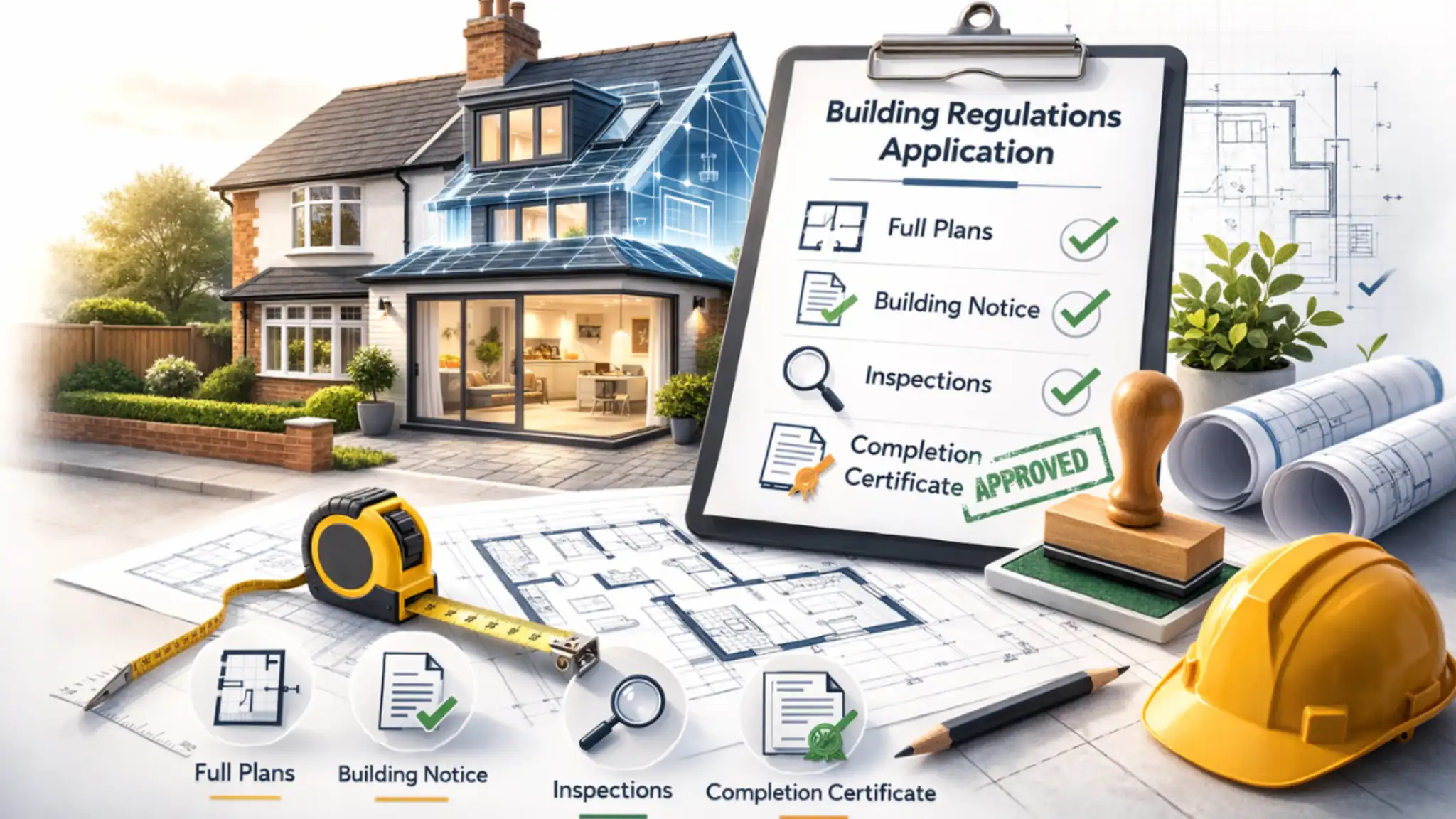
A Building Regulations Application is how you notify Building Control about building work and get inspections (and, ultimately, a completion certificate). Even if your project doesn’t need planning permission, it may still need Building Regulations approval.
- Most common routes: Full Plans (best for clarity) or a Building Notice (faster start, more risk).
- Best time to apply: before work starts — it’s cheaper and far less stressful than fixing issues later.
- What you’ll need: a clear scope, drawings (often), specs/insulation details, and sometimes structural calculations.
- What you get at the end: a completion certificate (important for selling/remortgaging).
In this guide we explain which application type to choose, what Building Control will want to see, typical timescales, and how to avoid the common mistakes that cause delays (or expensive remedial work).
Not sure which Building Control route you should use?
Tell us what you’re building and we’ll help you choose the safest, smoothest approval path (and what drawings you’ll actually need).
Quick summary: Building Regulations Application
A Building Regulations Application is the formal process of getting Building Control involved in your project — checking that the work meets safety and performance standards (structure, fire safety, insulation, drainage, ventilation and more).
In most cases, you’ll choose either Full Plans (drawings checked before you start) or a Building Notice (you start sooner, but you carry more risk if details don’t comply).
What is a Building Regulations application (and when do you need one)?
If you’re extending, converting, altering structure, changing drainage, or adding certain electrics and heating, Building Regulations often apply. The purpose is simple: Building Control checks your work is safe, energy efficient and meets minimum standards.
A Building Regulations application usually matters for projects like:
- extensions (single or double storey), structural openings and steel beams,
- loft conversions and garage conversions,
- new or altered bathrooms/kitchens where drainage is changed,
- new windows/doors in certain circumstances,
- electrical work covered by Part P (not all jobs, but many),
- internal alterations that affect fire escape routes (common in lofts and layout changes).
If you’re new to the topic, it can help to read our main guide onhow Building Regulations work for homeownersbefore you decide your application route.
Building Regulations vs planning permission: what’s the difference?
Homeowners often assume one approval “covers everything”. In reality, these checks answer different questions:
- Planning permission focuses on how your proposal affects the outside world — appearance, neighbours, highways, conservation policies and local planning rules.
- Building Regulations focus on technical compliance — structure, insulation, ventilation, drainage, electrics, fire safety and safe access.
That’s why it’s completely possible to have:
- planning permission granted, but Building Control asks for changes (for example insulation thickness, drainage details or fire protection), or
- no planning permission needed, but Building Regulations still required (very common for conversions and internal structural work).
If you want the planning side explained in plain English, our guide onplanning permission for homeownersis a useful companion read.
Building Regulations application types: Full Plans vs Building Notice
There are a few ways to make a Building Regulations application, but most homeowners choose between Full Plans and a Building Notice.Choosing the right one early saves time later.
Full Plans application (best for clarity and lower risk)
With Full Plans, you submit drawings and details up front. Building Control checks them and either approves, asks for changes, or requests more information. In practice, this gives you a clearer “paper trail” before you spend money on site.
- Best for: extensions, loft conversions, structural alterations, and anything slightly complex.
- Why homeowners like it: you reduce on-site surprises and you can price the job more accurately.
- Typical supporting package: drawings, construction notes/specifications, and sometimes structural calculations.
If you want a deeper comparison, our article onthe Building Notice vs Full Plans routewalks through pros/cons in more detail.
Building Notice (faster start, but you carry more risk)
A Building Notice is more like “permission to start” with fewer details required up front. That can sound attractive, but there’s a trade-off: if Building Control later decides something doesn’t comply, it’s on you (and your builder) to change it.
- Best for: smaller, straightforward work where details are standard.
- Risk: compliance issues can show up mid-build (costly and stressful).
- Common pain point: you may end up paying for drawings/specs anyway if questions arise.
What about a Regularisation Certificate?
If the work has already been done without approval, the route is different. You may need a Regularisation application (and you may have to open up parts of the build so Building Control can inspect what’s hidden).It’s always easier to apply properly before you start.
If this is your situation, this guide will help:what a Regularisation Certificate is and when you need one.
What is required for a Building Regulations application?
What you need depends on the route you choose and the complexity of your build. However, Building Control generally want enough information to confirm the work will comply — and enough access to inspect it during the build.
Typical information Building Control ask for
- Basic project details: address, description of work, and who is doing it.
- Drawings: existing/proposed plans and key construction details (more likely for Full Plans).
- Insulation and energy info: U-values, ventilation strategy and relevant details (Part L and Part F commonly come into play).
- Structure: beam sizes, padstones, joists, roof changes and structural calculations where needed.
- Fire safety basics: escape routes, doors, smoke alarms, and separation where required (especially in loft conversions).
- Drainage: if you’re moving pipes, adding bathrooms, or changing external drainage runs.
For many projects, the “missing piece” is the level of drawing detail. Planning drawings are often not enough for Building Control — which is why homeowners frequently progress from planning drawings to a Building Regulations set.
If you’re trying to work out what drawings you need, this guide explains it clearly:what drawings are needed for Building Regulations.
Quick costs snapshot: what affects Building Regulations fees?
Fees vary by council and by the size/complexity of the project. Instead of fixating on a single number, it’s more useful to understand what drives the cost:
- Project size and value (larger builds typically cost more to check and inspect).
- Application route (Full Plans vs Building Notice can be priced differently).
- Number of inspections needed (complex builds usually need more visits).
- Extra technical input (structural engineer, SAP/energy modelling in some cases, specialist fire details).
How long does a Building Regulations application take?
Timescales depend on the route you choose, how complete your information is, and how busy the Building Control team are.The good news is that most delays are avoidable — they usually come from missing details rather than the council being “awkward”.
Typical timing pattern (what homeowners experience)
- Full Plans: allow time for plan checking and any back-and-forth to resolve queries before you start.
- Building Notice: you can often start sooner, but questions may be raised during inspections.
- Completion certificate: issued once inspections are satisfied and any paperwork is in (for example electrical certificates where relevant).
Want us to sense-check your drawings before you submit?
We can review what you have, flag the common gaps Building Control come back on, and advise the cleanest submission route.
Step-by-step: how to apply for Building Regulations approval (and pass inspections)
Here’s the homeowner-friendly process we use to keep things simple and avoid “surprise” changes on site.
Building Regulations application checklist (simple table)
| Step | What to do | Why it matters |
|---|---|---|
| 1) Define the scope | Write down exactly what you’re building and what’s changing (structure, openings, drainage, electrics, insulation). | Stops miscommunication and reduces Building Control queries. |
| 2) Choose the route | Pick Full Plans for certainty, or Building Notice for simpler work where details are standard. | The route affects risk, timing, and what you need to submit. |
| 3) Prepare drawings/specs | Compile plans and key construction details (and get structural calculations if needed). | This is the biggest difference between a smooth approval and repeated questions. |
| 4) Submit and respond quickly | Submit the application and answer any plan-check queries clearly (with updated drawings if needed). | Most delays happen when questions sit unanswered. |
| 5) Book inspections | Agree inspection points with your builder (foundations, structure, insulation, drainage, completion). | If you miss an inspection stage, you may have to open up finished work. |
| 6) Collect certificates | Keep any relevant paperwork (e.g., electrical sign-off where applicable) and request the completion certificate. | You’ll likely need it for selling, remortgaging, and peace of mind. |
If you’d like to understand what Building Control look for during visits, our guide onwhat happens at Building Control inspectionsis a helpful next read.
Common Building Regulations application mistakes (and how to avoid them)
Most homeowner problems come from one of three things: starting too early, relying on vague drawings, or assuming the builder will “handle it”.A little planning up front prevents a lot of expensive rework later.
Other common pitfalls
- Mixing up planning drawings with Building Regulations drawings: planning-level information often isn’t detailed enough to prove compliance.
- Not budgeting for structural input: structural calculations are often needed for openings, steels and altered roof structures.
- Fire safety not considered early: loft conversions and altered layouts can trigger extra requirements (escape routes, doors, alarms).
- Insulation and ventilation left vague: these are frequent query points because they’re easy to under-specify.
Related comparisons homeowners search for
If you’re still piecing the whole approval picture together, these comparisons usually clear things up:
- Building control application vs planning permission: different tests, often both needed.
- Full Plans vs Building Notice: certainty first, or speed first.
- Approval vs completion certificate: you’ll want the final certificate at the end for your records.
For a more detailed explanation of how Building Control works in practice, see:what Building Control is and how to pass first time.
Local council quirks (what can vary)
While the Building Regulations themselves are national, the day-to-day process can feel slightly different depending on where you are.For example, some councils are quicker at plan checking than others, and some ask for more detail up front.
FAQs: Building Regulations application
How do you get Building Regulations approval?
You submit an application to Building Control (usually Full Plans or Building Notice), provide the required information, and then arrange inspections at key stages. Once the work is completed and any supporting certificates are provided where relevant, Building Control can issue the completion certificate.
Do I need Building Regulations approval if my project is permitted development?
Often, yes. Permitted Development only relates to planning permission. Building Regulations are separate, and many common home projects (extensions, conversions, structural alterations and certain electrics) still require Building Control involvement even when planning permission is not needed.
Can you start building before Building Regulations are approved?
It depends on the route, but starting without a clear plan is risky. A Building Notice may allow a quicker start, whereas Full Plans is designed to get the technical details checked first. Either way, you should make sure Building Control are properly notified and inspections are booked at the right stages.
How long does Building Regulations approval take?
Timescales vary with workload and how complete your information is. Full Plans can involve plan-check queries that need answering before you have certainty, while Building Notice can move faster at the start but may raise more questions during the build. The fastest outcomes usually come from submitting clear drawings and specs first time.
Is Building Regulations approval the same as a completion certificate?
Not quite. “Approval” usually refers to the application being accepted and (for Full Plans) the plans being checked. The completion certificate is the document issued at the end, once Building Control are satisfied the work complies. The completion certificate is the one you’ll want to keep safely.
What happens if no Building Regulations approval was obtained?
You may need to apply for regularisation and prove the work complies, which can involve opening up parts of the build for inspection. This can be more expensive and disruptive than doing it correctly up front, so it’s always best to get Building Control involved before work starts.
Who approves Building Regulations?
Building Control can be provided by your local authority Building Control team or an approved inspector, depending on your project and what you choose. They assess information, carry out inspections, and confirm compliance through the certification process.
Are Building Control applications public?
Planning applications are generally publicly searchable, but Building Control information is not typically published in the same way. Access and visibility can vary by council, so if you need something specific (for example for conveyancing), it’s best to ask the relevant Building Control body directly.
Want to avoid Building Control delays?
We can help you prepare a clear set of drawings and details so your project is easier to approve and easier to build.
Next steps & useful guides
These guides pair well with this Building Regulations application walkthrough:
- Building Regulations: Complete Homeowner’s Guide
- What approval means (and what it doesn’t)
- Building Control: what it is and how to pass first time
- What to expect at Building Control inspections
- What drawings you need for Building Regulations
- Why the completion certificate matters
- Regularisation Certificate: sorting past work
- What it isThe formal process of notifying Building Control and demonstrating your work complies with national Building Regulations.
- Most common routesFull Plans (checked before you build) or Building Notice (quicker start, higher risk).
- What Building Control look atStructure, insulation/energy, ventilation, drainage, fire safety, and safe access (depending on your project).
- Best homeowner moveSubmit clear drawings and specs first time — most delays are caused by missing details.
- Most important outcomeA completion certificate at the end (keep it safe for future sale/remortgage).
- Biggest avoidable mistakeStarting work without the right route chosen and inspections planned.
If you want a quick, practical steer on the best route for your project, message Plans Made Easy and we’ll point you in the right direction.
Official guidance
For trusted national guidance (and to sense-check what permission you may need), it’s worth checking:
- Planning Portal – national planning guidance and application information
- GOV.UK – planning permission in England and Wales
How Plans Made Easy can help
A Building Regulations application doesn’t have to be complicated — but it does need the right level of detail.When drawings and specs are clear, Building Control queries drop sharply, inspections go smoother, and builders can price and build with confidence.
Our team can prepare compliant drawings, coordinate technical details, and guide you through the approval process so you avoid delays and avoid “open it up again” problems later.
Ready to move your project forward?
Plans Made Easy can prepare compliant plans, manage submissions, and guide you from idea to approval.
Performance Verified ✅
This page meets PME Optimisation Standards — achieving 95+ Desktop and 85+ Mobile PageSpeed benchmarks. Verified on

