
Share this post:
Quick summary: House Extension Cost
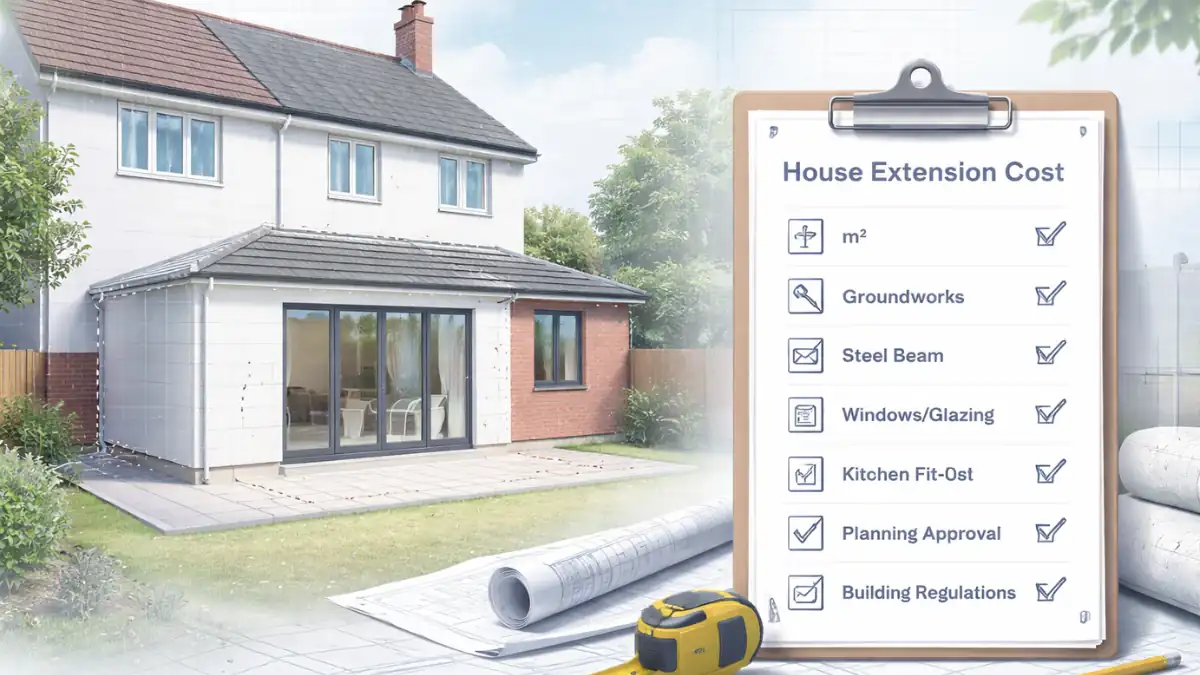
If you’re trying to budget for a House Extension Cost in the UK, the honest answer is: it depends on the size, complexity, and how “finished” you want it. However, most homeowners can still get to a realistic ballpark early on — if you break the budget into the right buckets.
- Typical build-only budgets often land somewhere in the £1,800–£3,500 per m² range (very roughly), but high-spec finishes, awkward access, or structural work can push higher.
- Your “all-in” cost should also allow for design + surveys, planning (if needed), Building Regulations, structural calculations, and contingency.
- The most common mistake is budgeting for the new room only — but forgetting about things like electrics upgrades, drainage, steelwork, kitchen/utility fit-out, and making good.
Below, we’ll show you a calm, homeowner-friendly way to estimate extension costs, understand what drives quotes up, and avoid the usual hidden extras that cause budget stress later on.
Quick summary: House Extension Cost
If you’re trying to budget for a House Extension Cost in the UK, the honest answer is: it depends on the size, complexity, and how “finished” you want it. However, most homeowners can still get to a realistic ballpark early on — if you break the budget into the right buckets.
- Typical build-only budgets often land somewhere in the £1,800–£3,500 per m² range (very roughly), but high-spec finishes, awkward access, or structural work can push higher.
- Your “all-in” cost should also allow for design + surveys, planning (if needed), Building Regulations, structural calculations, and contingency.
- The most common mistake is budgeting for the new room only — but forgetting about things like electrics upgrades, drainage, steelwork, kitchen/utility fit-out, and making good.
Below, we’ll show you a calm, homeowner-friendly way to estimate extension costs, understand what drives quotes up, and avoid the usual hidden extras that cause budget stress later on.
Not sure what your extension should actually cost?
Tell us your rough size, location and finish level, and we’ll help you sense-check your budget before you get too far into quotes.
Quick summary: House Extension Cost
A realistic House Extension Cost budget is usually built from three parts: (1) build cost, (2) professional + approvals, and (3) contingency.If you only focus on the builder’s number, you can end up under-budgeting — even when the quote looks “reasonable”.
In this guide, we’ll keep things simple and practical: how costs are typically calculated (including per m²), what a quote should include, and the choices that make the biggest difference to your final spend.
This article supports our main guide on budgeting for projects here:Extension Costs – Complete Homeowner's Guide (UK).
House Extension Cost: typical UK ranges and what they really mean
Most homeowners start with one big question: “How much does a house extension cost in the UK?”The tricky bit is that two extensions of the same size can cost very different amounts — because the real drivers are complexity, access, structure, and specification.
To keep things homeowner-friendly, we usually recommend thinking in budget bands rather than a single “magic number”:
- Lower-complexity, simple finish (straightforward footprint, simple structure, basic finishes): tends to sit at the lower end of typical ranges.
- Mid-range, most common family extensions (kitchen/diner with some structural work, decent finishes): often lands in the middle of typical ranges.
- High-spec or high-complexity (large openings, steels, tricky ground/drainage, premium glazing/finishes): pushes toward the upper end quickly.
If you want a calm way to get to a sensible figure early, focus on: the size, the structure, the level of finish, and the risk items (groundworks, drainage, steelwork, access).We’ll break those down below.
Quick costs snapshot: what to budget for beyond the “build”
- Build works: foundations/groundworks, structure, roof, windows/doors, first fix, second fix, plastering, finishes.
- Professional costs: measured survey, design, planning drawings (if needed), Building Regulations drawings, structural calculations.
- Approvals + checks: council fees (if a planning application is needed), Building Control fees/inspections.
- Common extras: kitchen/utility supply, flooring, decoration, landscaping/patio, drainage alterations, electrics upgrades.
- Contingency: a sensible allowance to cover surprises and scope changes.
House extension cost per m²: a useful starting point (with limits)
You’ll see “house extension cost per m²” discussed everywhere because it’s a quick way to get an early estimate.Used carefully, it can be helpful — but it’s not a quote, and it’s not a guarantee.
Why cost per m² can be misleading
Cost per m² works best when you’re comparing similar projects. If your extension needs lots of steelwork, major drainage changes, or complex glazing,your cost per m² can jump even if the extension isn’t that large.
How to use per m² sensibly
- Start with your approximate internal floor area (m²).
- Apply a cautious range rather than one number.
- Add a separate allowance for kitchens/bathrooms, glazing, and structural openings (because those often distort the average).
- Don’t forget professional fees + approvals and a contingency.
If you’ve been looking at “house extension cost calculator” tools online, treat them the same way: fine for a first estimate, but they can’t see your drains, your ground, or your structure.A good budget comes from a realistic scope and drawings that define what’s being built.
What pushes house extension costs up (and how to control it)
If you’re wondering why house extensions can feel “so expensive”, it’s usually because several cost drivers stack up at once.Here are the most common ones we see, and what you can do about them.
1) Groundworks and drainage changes
Groundworks are one of the biggest “unknowns” early on. Poor ground, deep foundations, or having to move/bridge drains can add cost quickly.If you’re building near public sewers, you may also need extra approvals.
Helpful read: what to check before building near drains and sewers.
2) Structural openings and steelwork
Large open-plan spaces often mean removing load-bearing walls and adding steels.The more structure you change, the more detail you need — and the more you should expect to pay.
Helpful read: when structural calculations are needed (and what they cover).
3) Access, logistics, and site constraints
Tight side access, no driveway, restricted working hours, or a terraced location can push labour and programme costs up.This is one reason you’ll often see higher pricing in London and the South East — not just “because it’s London”.
4) Finish level (this is where budgets quietly blow)
A basic “room shell” is one thing. A completed kitchen-diner with premium glazing, underfloor heating, a new kitchen, and high-end flooring is another.Two projects can look similar in photos, but the spec can be miles apart.
5) Changes mid-build
Late changes (moving doors, adding rooflights, altering layouts) often cost more than people expect — partly due to knock-on effects.A clear scope and clear drawings reduce variations.
Want a realistic cost range for your exact idea?
We can review your rough size, layout and constraints, then tell you what usually drives costs up (before you commit to quotes).
What does a house extension cost include?
One of the biggest causes of confusion is that different builders include different things in their pricing.So when you compare quotes, you’re sometimes comparing apples to oranges.
Items that should be clear in any quote
- Scope of work: exactly what’s included (and excluded).
- Groundworks: allowances, drainage assumptions, and what happens if the ground is worse than expected.
- Structure: walls, steels, floors, roof build-up.
- Openings: windows/doors/rooflights (including whether these are supply-and-fit).
- Electrics and plumbing: what’s included (and to what extent).
- Plastering, decoration and finishes: included or excluded?
- Making good: how the existing house is tied back in (both internally and externally).
- Provisional sums: what they cover, and the allowance figure.
If you want a smoother quoting process, your drawings and specification need to define the job properly.That’s where a well-prepared drawing package pays for itself — it reduces uncertainty and reduces the risk of nasty surprises later.
Helpful read: what drawings typically cover for homeowner projects.
Planning permission and Building Regulations: what you may need to budget for
Costs aren’t just about bricks and labour. Depending on what you’re building, you may also need to budget for approvals and technical information.This is where many online “house extension cost calculator UK” estimates fall short.
Do you need planning permission?
Some extensions can be done under Permitted Development, while others need a full planning application.It depends on things like size, height, location, and whether your home has restrictions (for example, conservation areas or Article 4 directions).
Start here: our guide to checking whether you need planning approval.
Building Regulations: almost always yes
Even if planning permission isn’t required, most extensions will need Building Regulations compliance (structure, insulation, ventilation, drainage, electrics, fire safety, and more).You’ll typically either go via Full Plans or a Building Notice, depending on the project and your risk tolerance.
- Read more: how Building Regulations apply to typical home projects
- And: what Building Control does and what inspections look for
Step-by-step: how to estimate your extension budget (without guesswork)
If you want a practical method to estimate a House Extension Cost before you’ve even picked a builder, use this approach.It’s simple, but it stops you forgetting the expensive bits.
Step-by-step checklist: building a realistic extension budget
- Define the type of extension. Rear, side, wrap-around, or two-storey? Each comes with different structural and access implications.
- Confirm your approximate size. Get a rough internal m² figure (even a sketch helps).
- Choose a finish level early. Basic, mid-range, or high-spec? This is one of the biggest cost levers.
- List the “risk items”. Drains, ground conditions, large openings/steels, access constraints, and tricky roof junctions.
- Add professional + approvals. Surveys, drawings, engineering, planning (if needed), Building Control.
- Allow for fit-out. Kitchens, bathrooms, flooring and decoration can be a large chunk of the total.
- Add contingency. A sensible buffer reduces stress if something unexpected crops up.
- Get quotes against clear information. Better drawings = more comparable quotes = fewer surprises.
If you want a deeper version of this process (including how homeowners typically phase spending), our pillar guide goes further:Extension Costs – Complete Homeowner's Guide (UK).
Hidden extras and “gotchas” that catch homeowners out
When homeowners tell us their extension “went over budget”, it’s rarely one dramatic event. More often, it’s a handful of common oversights.Here are the ones worth watching for.
Provisional sums that are too low
Provisional sums aren’t “bad” — but they need to be realistic. If allowances are too low, your final spend rises later.Ask what the allowance covers and what standard it assumes.
Kitchen/bathroom and glazing costs not fully allowed for
It’s very common for the building quote to cover the shell and basic services, while the kitchen/bathroom supply (and sometimes fitting) sits elsewhere.The same can happen with large glazing packages.
Electrics upgrades
Older properties sometimes need consumer unit upgrades or extra work once you start adding circuits.It’s best to discuss this early, rather than discovering it mid-build.
Party wall matters (if you share a wall)
If you’re in a terrace or semi-detached home, you may need to serve notice under the Party Wall etc. Act for certain works.That’s not a “build cost” — but it can be a project cost.
Helpful read: what party wall notices are and when you may need them.
FAQs: House Extension Cost
How much is a house extension in the UK?
It varies widely, because the total depends on size, structure, access, and finish level. A small, straightforward single-storey extension can sit at the lower end of typical ranges,while a larger open-plan extension with lots of steelwork, drainage changes, and premium glazing will cost significantly more. The best approach is to estimate using m² as a starting point,then add separate allowances for the high-cost items (kitchen/fit-out, glazing, steels, groundworks, and contingency).
How much does it cost to extend your house per m²?
Cost per m² is a useful starting point for early budgeting, but it’s not a quote. Two extensions with the same floor area can price very differently if one needs complex foundations,drainage changes, or large structural openings. Use a cautious range, and then adjust for complexity and specification.
Do I need planning permission to extend my house?
Sometimes yes, sometimes no. Some extensions can fall under Permitted Development, but others need a planning application — especially if you’re near limits on size/height, on a corner plot,in a conservation area, or your property has restrictions. A quick way to start is our guide here:step-by-step help with planning permission for extensions.
What does a house extension quote usually include?
A good quote should clearly define the scope (what’s included and excluded), and show how it handles big variables like groundworks and drainage.It should also be clear about windows/doors, electrics/plumbing extent, finishes, and any provisional sums. If something is vague, it’s worth asking for an inclusions scheduleso you can compare quotes properly.
Why are house extensions so expensive?
Costs rise when multiple “multipliers” stack up: awkward access, expensive groundworks, major structural alterations, high-end glazing, and a premium finish level.Also, extensions aren’t just new space — you’re tying new structure into an existing home, which often means more labour and more unknowns than people expect.
Is a house extension worth it?
For many homeowners, yes — but it depends on your goals. If you love your location, need more space, and can build within sensible budget limits,an extension can be a great long-term move. That said, “worth it” should include how you’ll live in the space, the disruption during works,and whether the finished layout genuinely improves the home (not just adds square metres).
Are house extensions a good investment?
They can be, especially when the new space fixes a genuine layout problem (for example, creating a workable kitchen/diner, adding a utility, or improving flow).However, the best investments usually come from good design decisions and controlled scope — not from chasing the biggest possible footprint.It’s also worth checking how your local market values extra space and improved layout.
Next steps & useful guides
If you’re working through budgets and want to reduce surprises, these guides are worth bookmarking:
- Our complete guide to budgeting for an extension project
- How the planning process works for extensions (and when it’s needed)
- Building Regulations explained for homeowners
- What Building Control inspections look for (and how to pass first time)
- Typical fees for drawing packages (and what should be included)
- When you’ll need an engineer and what calculations cover
- Best starting pointUse floor area (m²) for a first estimate, then adjust for groundworks, structure, access and finish level.
- Biggest cost driversGround conditions and drainage, steelwork/structural openings, high-end glazing, and kitchen/bathroom fit-out.
- Most missed itemsElectrics upgrades, drainage alterations, making good to existing rooms, and realistic provisional sums.
- Approvals to allow forPlanning permission (sometimes) and Building Regulations compliance (very often), plus Building Control fees/inspections.
- Best way to reduce surprisesClear scope + proper drawings + early decisions on finishes = more comparable quotes and fewer variations.
Want us to sense-check your expected House Extension Cost before you start collecting quotes?Contact Plans Made Easy and tell us your rough size, location and finish level.
Official guidance (useful for cross-checking rules)
For the latest national guidance, these are the most reliable starting points:
- Planning Portal – national planning guidance and application information
- GOV.UK – planning permission in England and Wales
How Plans Made Easy can help
Getting clear on House Extension Cost early makes the whole project calmer — because your quotes become easier to compare, your scope becomes clearer,and you’re far less likely to get caught by “missing” items halfway through the build.
If you want support, our team can help you define the right scope, prepare the drawings you need, and guide you through planning and Building Regulations so the project moves forward smoothly.
Ready to move your extension forward?
We can help you plan properly, avoid council headaches, and get a realistic budget before you commit.

Performance Verified ✅
This page meets PME Optimisation Standards — achieving 95+ Desktop and 85+ Mobile PageSpeed benchmarks. Verified on

