
Share this post:
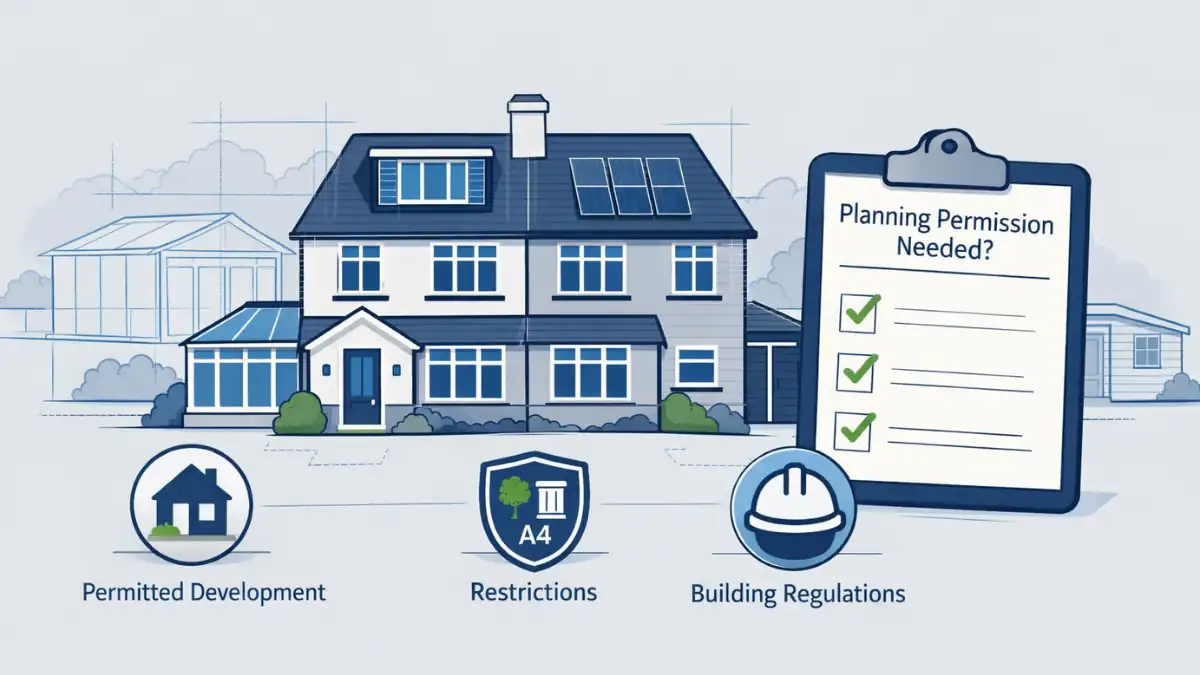
Quick summary: when is planning permission needed is usually answered by checking three things: whether the work counts as “development”, whether it falls under permitted development (PD), and whether your property has extra restrictions (like a conservation area, Article 4, or being listed).
Most common “yes” triggers
- Changes to the outside look (especially front/side elevations)
- Bigger extensions/loft changes beyond PD limits
- Extra restrictions (listed, conservation area, flats, Article 4)
Most common “maybe / check” projects
- Conservatories and single-storey extensions
- Garden rooms / outbuildings
- Solar panels, porches, sheds, decking
Key fact: Even where permission isn’t needed, you may still need building control approval (and sometimes a lawful development certificate is worth getting for peace of mind and future sale).
If you’re asking when is planning permission needed, you’re already doing the right thing — because the easiest way to turn a straightforward home project into a headache is to start building before you’ve checked the rules. In this guide, we’ll explain how the UK system works in plain English (assuming England), plus the common “yes / no / maybe” scenarios homeowners run into.
For a deeper overview of how applications work from start to finish, you can also readour complete homeowner guide to the process.
Important: The rules can change depending on your council and your property. Flats/maisonettes, listed buildings, and many homes in protected areas have tighter limits, even for work that would otherwise be “normal”.
Want a clear “yes / no” answer for your exact home?
Share what you’re planning and we’ll help you work out the right route — including whether a certificate is worth it.
Speak to our teamWhen is planning permission needed? The 3 triggers homeowners should check first
In England, you’re generally looking for these “triggers”. If one (or more) applies, you’re more likely to need consent — or at least get proper advice before spending money on builders.
1) Your work is “development” and it changes the outside of the building
If the proposal alters how your home looks from the outside (new walls, bigger roof forms, dormers, cladding, raised terraces, etc.), it often falls under development controls. That doesn’t automatically mean you must apply, but it does mean you need to check whether it’s covered by permitted development (PD).
2) The work goes beyond permitted development limits
Many common home improvements can be done without applying because they’re allowed under PD. However, PD comes with conditions and limits (size, height, position, materials, and how close the work is to boundaries). The Planning Portal explains how PD works at a high level. :contentReference[oaicite:0]{index=0}
3) Your home has extra restrictions
Even small changes can need consent where there are constraints such as:
- Listed buildings (you may need listed building consent for alterations that affect character). :contentReference[oaicite:1]{index=1}
- Conservation areas or other protected designations
- Article 4 Directions (which can remove PD rights)
- Flats/maisonettes (often have far fewer PD rights than houses)
- Past planning conditions that removed PD rights on your property
When planning permission is usually not needed: permitted development in plain English
Permitted development rights are a set of rules that allow certain home improvements without making an application, as long as you stay within the limits and meet the conditions. :contentReference[oaicite:2]{index=2}
Tip: If you’re relying on PD and you want maximum certainty for conveyancing later, a Lawful Development Certificate can be a smart move. It’s not always essential, but it can prevent awkward questions when you sell.
The catch is that PD is not “one-size-fits-all”. Your council can confirm constraints like conservation areas and Article 4 zones, and the government’s household technical guidance helps explain how PD works in practice. :contentReference[oaicite:3]{index=3}
Common homeowner projects: when is planning permission needed?
Below are the projects we’re most commonly asked about. Keep in mind: the final answer always depends on the exact design, where it sits on the plot, and any restrictions on your property.
When is planning permission needed for a conservatory?
Many conservatories can be done under PD on houses, particularly at the rear. However, you may need consent if it’s too large, too close to boundaries, affects the front/side elevation in a sensitive way, or the property has restrictions. If you’re also removing walls or doing structural changes, building control becomes important too.
Related read: our guide to extending a home without nasty surprises.
When is planning permission needed for solar panels?
Solar panels are often allowed, but there are still rules about how they’re installed (especially in protected areas or on listed buildings). If your home is listed, don’t assume “small” equals “fine” — you’ll usually need specialist advice and the correct consents. :contentReference[oaicite:4]{index=4}
When is planning permission needed for a loft conversion?
Some loft conversions fall under PD, but dormers, roof height changes, front-facing alterations, and designs that push beyond volume/height limits often trigger the need for an application. Roof alterations are also one of the areas where “neighbour impact” can become a deciding factor (overlooking, bulk, and street scene).
Related read: our loft conversion guide covering process, risks, and approvals.
When is planning permission needed for a porch?
Porches can sometimes be done without applying, but it’s easy to get caught out when a porch is too large, too close to a boundary with a highway/footpath, or changes the front elevation in a way the council considers harmful — especially on prominent streets.
Related read: our porch checklist with the common pitfalls.
When is planning permission needed for a garden room?
Many garden rooms / outbuildings can be built under PD if they stay within height and positioning limits and remain “incidental” to the main home (think home office or gym rather than a separate dwelling). You’re more likely to need consent if it’s tall, close to boundaries, used for sleeping, or in a restricted area.
Related read: our guide to outbuildings and home offices in the garden.
When is planning permission needed for a garage conversion?
Converting a garage into habitable space doesn’t always require an application, but it often triggers building regulations. Planning can still be needed where the conversion changes the front appearance, affects parking standards in your area, or where PD rights were removed by conditions on the original development.
Related read: our garage conversion guide explaining the approvals.
When is planning permission needed for a shed?
Sheds are commonly allowed under PD, but size, height, location, and use matter. The moment it starts to feel like a “building project” rather than simple storage, it’s worth checking properly.
Related read: our shed rules checklist (sizes, heights, and common council quirks).
When is planning permission needed for decking, raised terraces, or big level changes?
Decking and raised platforms can create overlooking issues, especially in terraced streets and tight plots. Height above ground level is often the factor that changes the answer, so it’s a “measure twice” situation.
When is planning permission needed for a driveway or dropped kerb?
A new access onto the highway and a dropped kerb typically involve council/highway authority approval, and sometimes a separate application route. If you’re adding hardstanding at the front, drainage rules and local design guidance can also come into play.
When is planning permission needed for demolition?
Demolition can be sensitive, particularly in conservation areas and for heritage assets. Always check with your local authority before arranging works, because the consent type (and process) may differ depending on what you’re demolishing and where.
Where permission is more likely: restrictions, special cases, and council “quirks”
Listed buildings (and some homes near them)
If your home is listed, you’ll usually need listed building consent for works that affect its special character — and that can include internal changes as well as external alterations. :contentReference[oaicite:5]{index=5}
Conservation areas and Article 4 Directions
Protected areas can limit what you can do without applying, especially for changes visible from the street (windows, doors, cladding, roof materials, and sometimes solar). Article 4 Directions can remove PD rights altogether, which is why a quick online PD assumption sometimes backfires.
Flats and maisonettes
Many PD rights that apply to houses don’t apply in the same way to flats. If you live in a flat/maisonette, treat “do I need consent?” as the default question — not the exception.
Previous conditions on your property
Modern estates sometimes come with conditions that remove PD rights (for example, requiring permission for extensions, roof changes, or even outbuildings). If you’re not sure, we can help you check the decision notice history.
Planning vs building regulations: the mix-up that causes most delays
Planning controls whether you’re allowed to do the development in principle (size, siting, appearance, neighbour impact). Building regulations focus on how it’s built (structure, insulation under Part L, fire safety under Part B, electrics under Part P, ventilation, drainage, and so on).
That’s why you can be “fine” on one and still fail the other. If you’re doing an extension, conversion, structural opening, or anything involving insulation/electrics, assume building control matters.
Helpful next steps:our homeowner guide to building regulationsandwhat building control actually does during a project.
Need drawings that keep the council (and building control) happy?
Clear drawings reduce delays, avoid invalid applications, and help builders price accurately.
See what drawings you needHow to check properly before you build (simple step-by-step)
- Describe the work clearly (size, height, location, and what’s changing externally).
- Confirm your property type (house vs flat; listed status; conservation area/Article 4).
- Check PD rules using official guidance, then compare your proposal to the limits and conditions. :contentReference[oaicite:6]{index=6}
- Look for past constraints in old decision notices (conditions removing PD rights are common).
- Decide the safest route:
- If it’s clearly within PD, consider a certificate for peace of mind.
- If it’s borderline, tweak the design early (cheaper than redesigning mid-application).
- If it’s outside PD or in a sensitive area, plan for an application and strong drawings.
Note: Homeowners often ask “how long is consent valid for?”. In most cases, you have three years from the decision date to begin the development unless your decision notice says otherwise. :contentReference[oaicite:7]{index=7}
What happens if you don’t apply (and you needed to)?
Most people don’t set out to do anything wrong — they just assume a builder’s “it’ll be fine” is enough. The problem is that if consent was required and you didn’t get it, you can run into issues later, such as:
- Enforcement risk (which can mean changes or even removal in worst cases)
- Delays when selling (solicitors ask for evidence of consents and compliance)
- Extra cost if you need retrospective applications, redesign, or supporting reports
If you’re worried about something that’s already been done, it’s better to check sooner rather than later — and keep the paperwork you do have.
Related read: our guide to the documents you should keep for future sale.
FAQs: when is planning permission needed?
Is planning permission required for permitted development?
If something genuinely qualifies as permitted development, you don’t normally need to apply. The key is proving your design meets the PD limits and that your home has PD rights (some don’t). If you want certainty, consider a lawful development certificate.
How long is planning permission valid for?
In most cases you have three years from the decision date to start the development, unless your decision notice says otherwise. :contentReference[oaicite:8]{index=8}
Who approves planning permission?
Your local planning authority (your council) makes the decision, usually based on planning policy, design guidance, and neighbour/public comments. Some applications are decided by officers under delegated powers; others go to a planning committee.
How is planning permission granted?
Once submitted, the council validates the application, consults neighbours and relevant departments, then assesses it against policy. If approved, you’ll receive a decision notice (often with conditions you must follow).
Which planning application do I need?
For most home projects, it’s a householder application (extensions, dormers, porches). Some situations need different consent types (for example listed building consent for listed homes). If you tell us what you’re building and where, we’ll point you to the right route.
Will planning permission be granted?
It depends on design, neighbour impact, and local policy. Strong drawings and a proposal that respects scale, privacy, and appearance usually performs better than “maxed out” designs.
What happens when planning permission is granted?
You’ll get a decision notice and (often) conditions. Read the conditions carefully — some need to be discharged before work starts. Also remember most permissions have a time limit to begin. :contentReference[oaicite:9]{index=9}
What happens if you don’t apply and you needed to?
You could face enforcement action, problems selling, or extra cost putting things right. If the work is already done, it’s usually best to get advice and gather evidence (drawings, photos, dates, and certificates) before taking next steps.
When is planning permission not needed in Scotland?
Scotland has a different planning system and different permitted development rules. This article assumes England, so if you’re in Scotland it’s important to check Scottish guidance (or ask your local authority) before relying on an England-based checklist.
Still unsure when is planning permission needed for your project?
Send us the basics (address area, property type, and what you want to build) and we’ll help you choose the safest route — so you can move forward with confidence.
Get expert help
Performance Verified ✅
This page meets PME Optimisation Standards — achieving 95+ Desktop and 85+ Mobile PageSpeed benchmarks. Verified on

