
Share this post:
Drawings for House Extensions
When you're planning a house extension, the drawings you submit can make or break your application. Clear, accurate, and fully compliant drawings for house extensions help your Local Planning Authority understand exactly what you’re proposing — and they dramatically reduce the risk of delays, invalidations, or refusals.
In this guide, we explain the types of drawings you need, how they fit into the planning process, the difference between planning drawings and building regulations drawings, and what to expect when commissioning them.
This article supports our main Pillar Guide: Planning Permission Drawings.
Unsure which drawings you actually need?
We’ll help you understand exactly what’s required for your extension and keep you compliant from day one.
What Are Drawings for House Extensions?
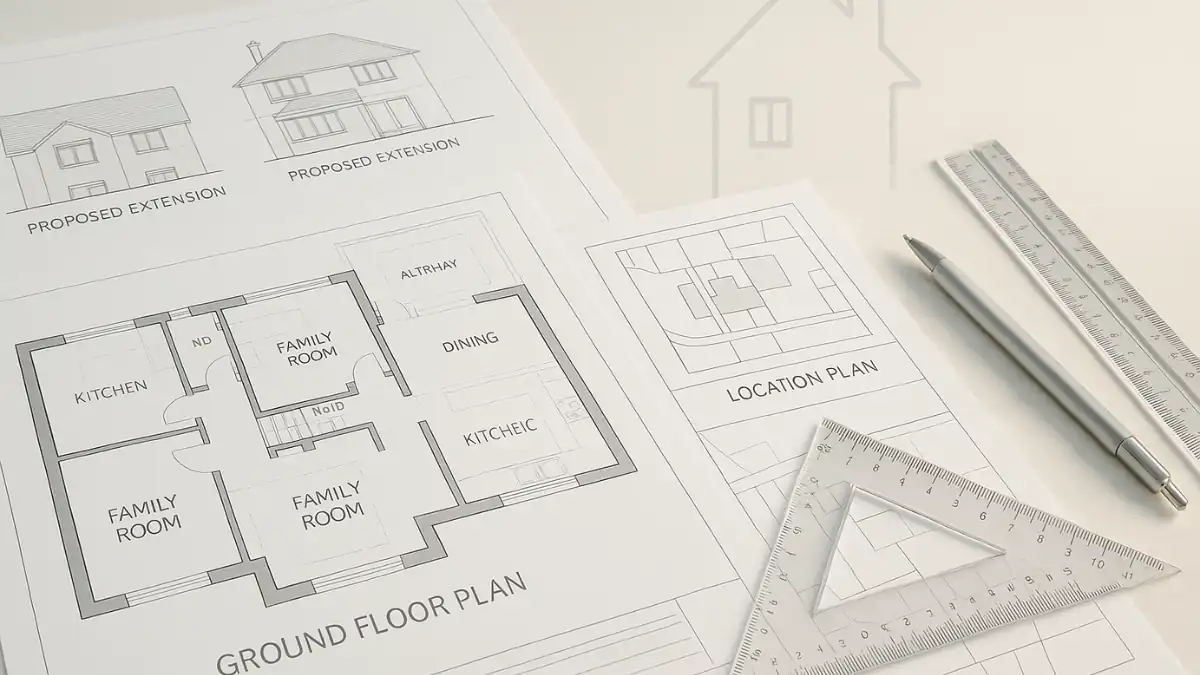
Drawings for house extensions are the set of plans, elevations, and technical details that visually explain what you intend to build. These drawings tell your Local Planning Authority (LPA) exactly how your extension will look, how big it is, and how it relates to your existing home.
They don’t just help the council approve your project — they also ensure your builder knows precisely what to build and help avoid costly surprises during the work.
If you're still at the early stage of planning, our guides on Planning Permission Drawings and Making Plans give a wider overview of the process.
Types of Drawings You Need for a House Extension
Most UK homeowners will need a full set of planning drawings before they submit an application or use the Permitted Development route. Although the exact requirements can vary by council, the following drawings are almost always needed:
1. Existing Drawings
- Existing floor plans (showing current layout)
- Existing elevations (front, rear, side views)
- Existing roof plan
2. Proposed Drawings
- Proposed floor plans
- Proposed elevations
- Proposed roof plan
3. Supporting Documents
- Site location plan (OS map at 1:1250)
- Block plan (1:500)
- Design & access statement (some councils)
- Heritage statement (if in Conservation Area)
For more extension-specific detail, you may also find our dedicated Extension Drawings guide helpful.
Planning Drawings vs Building Regulations Drawings
Homeowners are often surprised to learn that planning drawings and building regulations drawings are completely different sets of documents. They serve different purposes and are reviewed by different departments.
Planning Drawings
These are simpler, visual drawings showing height, shape, size, and external appearance. They prove that your extension follows planning policies or the Permitted Development rules.
Building Regulations Drawings
These are far more detailed and include structural calculations, insulation details, fire safety provisions, drainage layouts and compliance with Parts A–P.
If you're unsure what building regulations require for extensions, our complete Building Regulations Guide and Plans for Building Regulations article provide a full breakdown.
Who Prepares the Drawings?
Most homeowners use a planning consultant, architectural designer, or architect. The right choice depends on the complexity of your project and whether you require detailed design support.
- Simple extensions: Architectural designers or planning specialists are usually cost-effective.
- Complex or unusual builds: An architect may be recommended.
- Structural changes: You’ll also need a structural engineer for calculations.
Not sure which drawings your extension needs?
We can check your project and prepare compliant drawings ready for planning or building control.
Costs & Timelines
Costs can vary depending on the size and complexity of the extension. Here’s a typical range for UK homeowners:
- Planning Drawings: £650–£1,500+
- Building Regulations Drawings: £900–£2,500+
- Structural Calculations: £300–£1,200 depending on beams and spans
- Typical Timeframe: 2–4 weeks for drawings; 8 weeks for council decision
For broader budget planning, see our detailed Extension Costs guide.
Step-by-Step: How to Get Your Drawings Prepared
| Step | What Happens |
|---|---|
| 1. Initial Consultation | Discuss ideas, budgets, restrictions and feasibility. |
| 2. Measured Survey | Designer visits your home to collect accurate measurements. |
| 3. Draft Drawings | Initial versions produced for review and feedback. |
| 4. Final Planning Drawings | Scaled plans, elevations, and location drawings prepared. |
| 5. Submission to Council | Your designer submits plans for Planning Permission or Lawful Development Certificate. |
Common Pitfalls & Gotchas
- Using outdated OS maps for the site location plan
- Not showing neighbouring windows or boundaries
- Missing ridge heights or eaves heights
- Submitting drawings in the wrong file format (PDF required)
- Incorrect orientation (north arrow missing)
If your extension might fall under Permitted Development, check our guide on Do I Need Planning Permission for an Extension?
Frequently Asked Questions
Do I need drawings for every type of house extension?
Yes — whether you’re using Planning Permission or Permitted Development, drawings are always required to show the council exactly what you intend to build.
Are planning drawings enough to build from?
No. Builders need detailed building regulations drawings and sometimes structural calculations to construct your extension safely and in compliance with Part A, B, L, and other relevant standards.
How accurate do the drawings need to be?
All drawings must be fully scaled, dimensioned, and based on a measured survey to avoid discrepancies during construction or the approval process.
Can I draw the plans myself?
Technically yes, but most self-drawn plans fail validation. Councils require professional standards for scale, detail, and layout.
How long do drawings take to prepare?
Most designers take 2–4 weeks depending on complexity and revisions.
Key Facts Snapshot
- You’ll Need: Existing + proposed plans, elevations, roof plans, site location plan.
- Two Types of Drawings: Planning drawings & building regulations drawings.
- Typical Cost: £650–£1,500 for planning drawings; £900–£2,500 for building regs.
- Timeline: 2–4 weeks for drawings; 8 weeks for Planning Permission.
- Best For: Any extension needing Planning Permission or Permitted Development certificate.
Next Steps & Useful Guides
- Planning Permission Drawings
- Drawings for Planning Application
- Extension Drawings
- Building Regulations
- Plans for Building Regulations
- Extension Costs
For further reference:
Ready to move your project forward?
Plans Made Easy can prepare compliant plans, manage submissions, and guide you from idea to approval.

Performance Verified ✅
This page meets PME Optimisation Standards — achieving 95+ Desktop and 85+ Mobile PageSpeed benchmarks. Verified on

